Neptu Weton: How to Calculate It and What It Means in Primbon Jawa
August 20, 2026
In Javanese tradition, nearly every important calculation begins with one small number called neptu. Neptu is a numeric value attached to each day of the week (Monday through Sunday) and to each pasaran day in the five-day market cycle (Legi, Pahing, Pon, Wage, Kliwon). When these two values are added together, the result becomes the foundation of a person's weton, the day-and-pasaran combination believed in Javanese primbon to hold its own distinct meaning.
This article focuses specifically on the neptu number itself, rather than simply how to find a weton from a birth date. You will find a complete neptu reference table, a clear explanation of how the values are summed, and the broader ways neptu is believed to be used in primbon Jawa, from reading personal character to calculating couple compatibility and choosing auspicious days for events.
What Neptu Means in Javanese Tradition
Neptu is the numeric weight assigned to each day and each pasaran in the Javanese calendar system. Every day has its own neptu value, and so does every pasaran. According to primbon, combining the two is believed to be more than a simple way of marking time, functioning instead as a symbol of the energy thought to shape a person's character, fortune, and life journey.
This concept has been passed down for generations as part of a much wider primbon system. Neptu itself serves as the numerical foundation, while its interpretation is believed to extend into many areas of life, including couple compatibility, choosing good days for events, and describing a person's character based on their weton.
The Complete Neptu Table for Days and Pasaran
To calculate neptu, you need to know two basic reference tables, the neptu for days and the neptu for pasaran. These tables are the standard references widely used in Javanese primbon, though some regional sources may carry small variations.
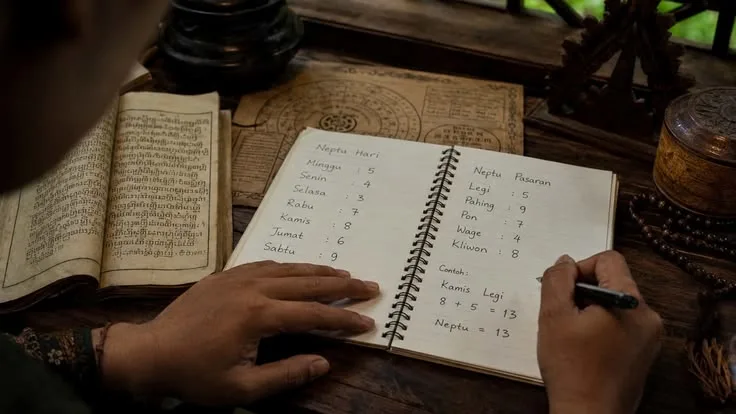
Day neptu values are as follows: Monday is worth 4, Tuesday is worth 3, Wednesday is worth 7, Thursday is worth 8, Friday is worth 6, Saturday is worth 9, and Sunday is worth 5. The pasaran neptu values consist of the five market days: Legi is worth 5, Pahing is worth 9, Pon is worth 7, Wage is worth 4, and Kliwon is worth 8. These two tables are the essential key to every neptu weton calculation that follows.
How to Calculate Your Own Neptu Weton
Calculating neptu is fairly simple once you know your weton, the combination of the day and pasaran on which you were born. The formula is simply adding the neptu value of your day to the neptu value of your pasaran. If you don't yet know your own weton, another article on this blog already covers how to find it from a birth date in full detail.
For example, someone born on a Wednesday that falls on Wage would have a neptu of 7 plus 4, which equals 11. Another example, someone born on a Monday that falls on Legi would have a neptu of 4 plus 5, which equals 9. This total is what primbon Jawa refers to as the neptu weton, and it forms the basis for many traditional interpretations that follow.
The Many Traditional Uses of Neptu in Primbon Jawa
Neptu is not only a tool for identifying someone's weton; it is a number believed to carry several other functions within primbon Jawa. There are at least three major traditional uses that still appear frequently in Javanese practice today.
First, neptu is believed to be used for reading a person's character and life potential based on their weton, covering traits, fortune, and certain personality tendencies. Second, neptu is used to calculate jodoh, or couple compatibility, by adding together the neptu totals of both partners, with the resulting number then interpreted according to primbon to gauge harmony in the relationship. Third, neptu is used to choose good days for important events, such as weddings, moving house, or starting a business, by comparing neptu totals against traditional day-selection guidelines passed down through generations.
Why the Same Neptu Number Can Come from Different Combinations
Because neptu is the result of addition, it is entirely possible for different day-and-pasaran combinations to produce the same total. For instance, Friday Pahing has a neptu of 6 plus 9, equaling 15, and Thursday Pon also has a neptu of 8 plus 7, equaling 15. Even though the numbers are identical, both wetons are still considered distinct in primbon.
This happens because Javanese primbon does not look at the total number alone, but also at the day-and-pasaran combination itself as a whole with its own distinct character. In other words, two wetons sharing the same neptu are not necessarily interpreted the same way, which means the neptu total should be understood as one element, not the only element, in reading the meaning of a weton.
Using Neptu Wisely Today
Neptu is best viewed as a living cultural tool for reflection, something carried on through generations, rather than a rigid formula that determines a person's fate absolutely. Many people in Java today use it as part of tradition, as a way of honoring ancestors, or simply as an additional consideration when planning an important event.
It is also worth knowing that different regions and primbon sources may carry small variations in interpretation, even though the basic neptu tables are generally consistent. For that reason, neptu weton is best understood as part of the rich cultural heritage many people believe in, not as a scientific certainty.
FAQ
What is neptu weton?
Neptu weton is the number formed by adding the neptu value of a person's birth day to the neptu value of their pasaran, which according to Javanese primbon becomes the basis for various traditional interpretations.
How do I calculate my own neptu weton?
Simply add the neptu value of your birth day to the neptu value of your pasaran, for example Wednesday worth 7 plus Wage worth 4, giving a total of 11.
What are the neptu values for the seven days?
Monday is 4, Tuesday is 3, Wednesday is 7, Thursday is 8, Friday is 6, Saturday is 9, and Sunday is 5.
What are the neptu values for the five pasaran days?
Legi is 5, Pahing is 9, Pon is 7, Wage is 4, and Kliwon is 8.
Why can two different wetons share the same neptu total?
Because neptu is a sum, different day-and-pasaran combinations can coincidentally add up to the same number even though their meanings are still considered distinct.
Does the same neptu total mean the same character?
According to primbon, not necessarily, since each day-and-pasaran combination is still believed to carry its own distinct character regardless of the total.
What is neptu commonly used for in primbon Jawa?
Neptu is believed to be used for reading personal character, calculating couple compatibility, and choosing good days for important events.
How is neptu used to calculate couple compatibility?
The neptu totals of both partners are added together, and the result is then interpreted according to primbon guidelines to assess harmony in the relationship.
How is neptu used to choose a good day for an event?
The combined neptu total is compared against traditional day-selection guidelines, which are believed to help determine favorable timing for weddings, moving house, or starting a business.
Is the neptu table the same across all regions?
Most primbon sources use a similar neptu table, though small variations may exist depending on regional traditions.
Should neptu weton be treated as absolute truth?
Neptu weton is better understood as cultural heritage and a tool for traditional reflection, not as a scientific formula that determines fate with certainty.
Do I need to know my weton before calculating neptu?
Yes, you need to know your birth day and pasaran first before you can add their respective neptu values together.
Understanding neptu weton opens up a deeper appreciation for the richness of primbon Jawa, especially since this one simple number is believed to play a role in so many aspects of life, from personal character to the choice of a good day. Read also Neptu, Pasaran, Wuku: What Is the Difference in Javanese Tradition?, or How to Calculate Weton from a Birth Date (With Examples) to explore the step-by-step process of finding a weton from a birth date in more depth.