Does the Universe Really Follow Your Weton? A Philosophical Inquiry
April 28, 2026
The Question at the Heart of Weton
When someone calculates their weton and finds that it describes their personality with startling accuracy, a natural question arises: is the universe actually structured around individual birth timing? And if so, what does this say about free will, fate, and the nature of reality?
These are not silly questions. They sit at the intersection of cosmology, philosophy, and lived experience.
The Javanese Cosmological View
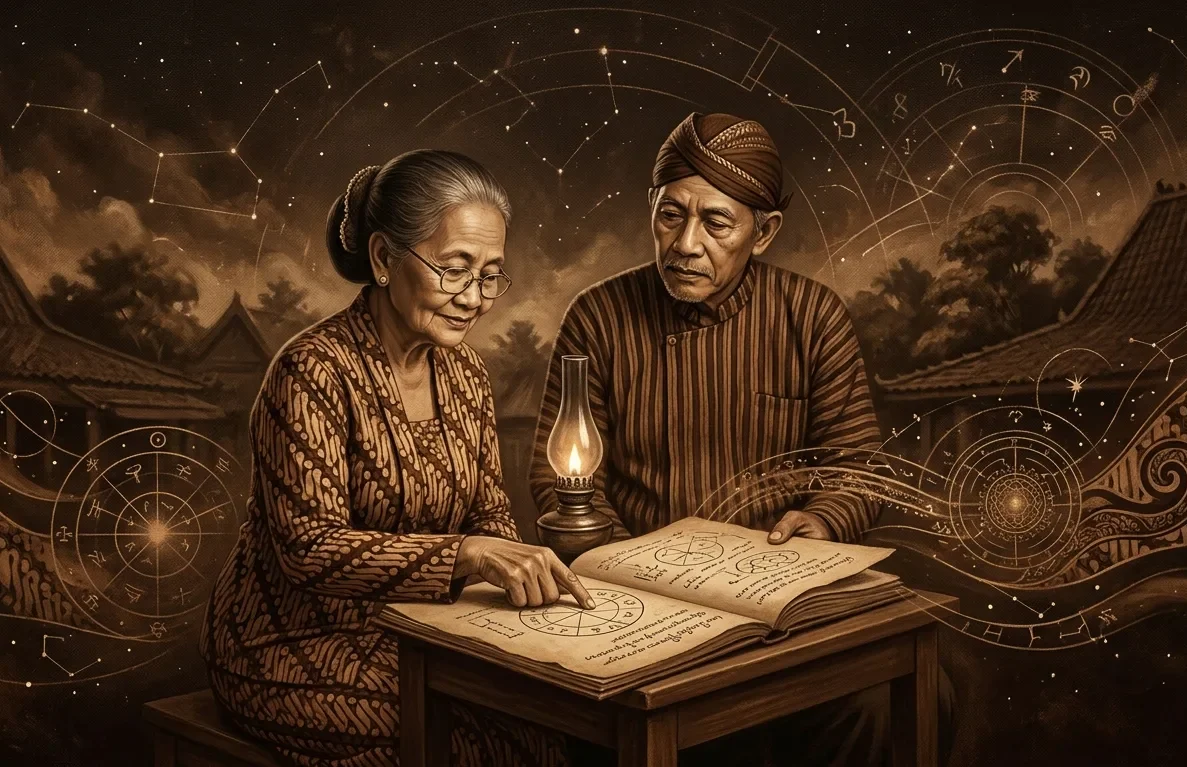
Javanese cosmology does not draw a sharp separation between the individual and the cosmos. The famous concept mikrokosmos-makrokosmos (microcosm-macrocosm) describes the human being as a miniature version of the larger universe — containing within the self the same forces, cycles, and energies that operate in the cosmos at large.
In this view, the quality of time at the moment of birth does not create a person's character from outside — it resonates with the character that is naturally unfolding. The cosmos and the individual are made of the same substance. When a person with Kliwon in their weton feels naturally drawn to spiritual inquiry, this is not the calendar controlling them; it is the recognition of a shared pattern.
The Anthropological View
From an anthropological perspective, weton and primbon represent something remarkable: generations of careful observation of human behavior patterns, encoded in a symbolic system that has been tested and refined across centuries of community life.
The "predictive" quality of weton may reflect less a cosmic mechanism and more a sophisticated cultural psychology — a tradition that has noticed genuine patterns in human tendency and encoded them in the accessible form of calendar timing.
Free Will and Weton
Javanese philosophy preserves a meaningful role for free will even within the weton framework. Your weton describes your starting configuration — your natural tendencies, energetic strengths, and characteristic challenges. What you do with that configuration remains yours entirely.
The Javanese concept of laku (ethical conduct, spiritual practice, the path one walks) exists precisely because character is shaped through daily choice, not determined at birth. Weton without laku is an unused map. Laku without weton awareness may involve unnecessary struggle against one's own nature.
The Honest Answer
Does the universe follow your weton? Philosophically honest answer: we cannot say with certainty. What we can say is that the weton system has offered meaningful reflection to millions of people across centuries. Whether the mechanism is cosmic resonance, cultural pattern-wisdom, or psychological projection matters less than whether the practice of attending to these patterns helps people live with more self-awareness, wisdom, and intentionality.
By that measure — which is the only measure that matters practically — weton is worth understanding.
Frequently Asked Questions
Is weton compatible with scientific worldviews?
Weton is not a scientific system — it is a cultural wisdom tradition. The two can coexist without conflict if weton is approached as a reflective tool rather than a predictive mechanism.
Does believing in weton require religious faith?
No. Many secular Javanese people engage with weton as a cultural heritage and reflective framework without any metaphysical belief.
What is the most intellectually honest way to approach weton?
Take it seriously enough to explore — apply what resonates, observe what doesn't fit, and let your own experience inform your conclusions. Approach it with curiosity rather than either dismissal or uncritical acceptance.