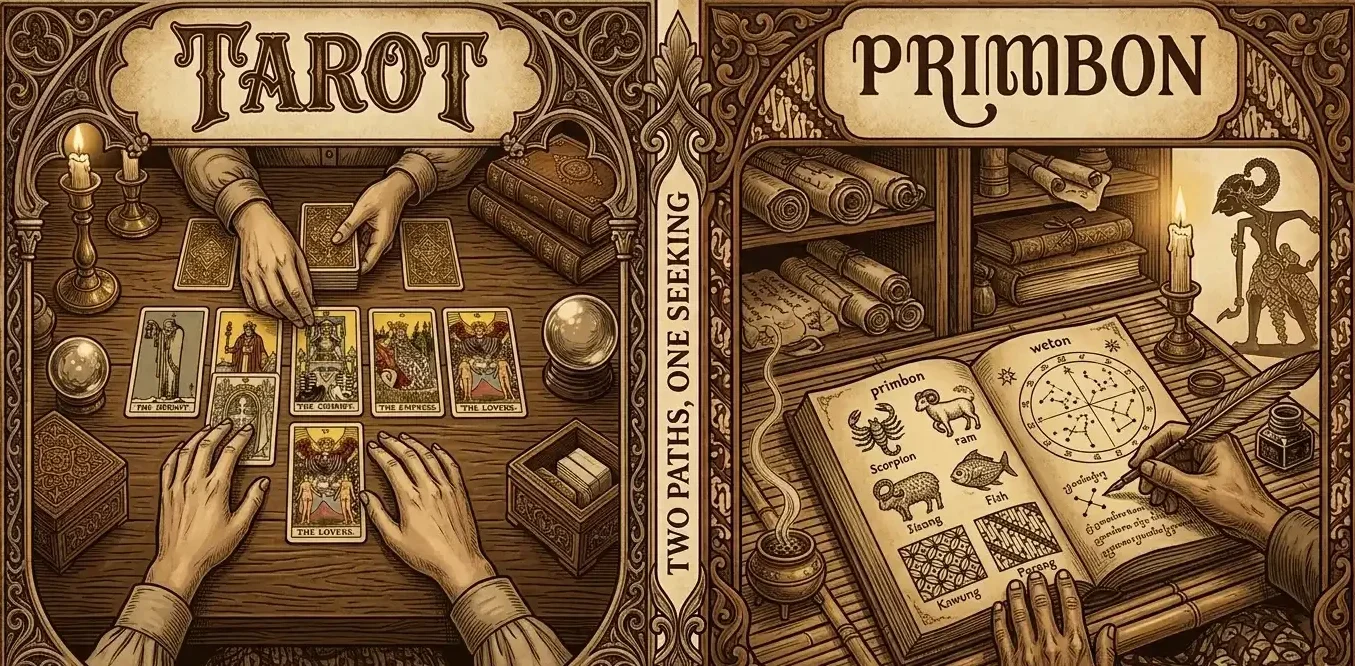
Tarot vs Primbon: Understanding Two Unique Spiritual Traditions
April 12, 2026
Two Traditions, One Purpose
Both tarot and primbon have endured across centuries and cultures. Both are used to seek insight, understand patterns, and navigate life's uncertain terrain. But beneath these surface similarities lie fundamentally different worldviews, methodologies, and philosophical assumptions.
Origins: Europe Meets Java
Tarot originated in 15th-century northern Italy as playing cards. They entered occult and divinatory use in the 18th century through esoteric European movements influenced by Kabbalah, Hermeticism, and later Jungian psychology.
Primbon grew from indigenous Javanese observation of nature, human behavior, and cosmic cycles — refined across generations of careful ilmu titen and recorded in manuscript form during the Hindu-Buddhist Majapahit era, later continuing through Islamic Javanese courts.
One tradition was born in European court games and esoteric movements. The other grew from agrarian and courtly Javanese observation of life itself.
Methods: Images vs Numbers
Tarot works through imagery. A reader draws cards and interprets the symbolic content of archetypes — the Tower, the High Priestess, the Fool — in relation to the seeker's question and situation. The interpretation is inherently flexible and reader-dependent.
Primbon works primarily through pattern calculation — neptu values, calendar cycles, and established correspondences between birth timing and life tendencies. While interpretation requires wisdom, the underlying system is more mathematically structured.
Philosophy: Revelation vs Recognition
The implicit philosophy of tarot (especially in Jungian-influenced approaches) is that the drawn cards reveal something already present in the unconscious — a form of psychic synchronicity.
Primbon's implicit philosophy is that time has embedded qualities, that humans are patterned beings woven into cosmic cycles, and that observation of these patterns over generations yields reliable wisdom about tendencies.
One reaches inward through image. The other reaches outward into the nature of time.
Both as Reflective Tools
Despite their differences, both tarot and primbon are most wisely used as reflective tools rather than literal prediction systems. They ask: what does this symbol or calculation invite you to notice? They work best when approached with curious openness rather than seeking fixed answers.
Frequently Asked Questions
Can I use both tarot and primbon?
Absolutely. They address different dimensions of reflection and can complement each other well.
Which is more accurate?
This question misframes both systems. Neither claims scientific predictive accuracy. Both offer frameworks for reflection that users find variously meaningful.
Do Javanese people use tarot?
Some do, particularly younger generations. The two systems are not considered incompatible in practice, even if their philosophies differ.