Larung Sesaji: Java's Sea Offering Tradition Explained
September 13, 2026
For communities living along Java's northern and southern coastlines, the sea is far more than water meeting the horizon. It is a source of livelihood and a force of nature that must be respected. Out of that respect grew a tradition passed down through generations called Larung Sesaji, known in many regions simply as sedekah laut, or "sea offering."
Sedekah Bumi is the agrarian community's expression of gratitude for the harvest the earth provides. Larung Sesaji is its maritime counterpart, and the distinction matters: Sedekah Bumi is rooted in farming life and the fertility of the soil, while Larung Sesaji grows out of the rhythm of fishing life and the generosity of the sea. Both are Javanese expressions of gratitude, yet each springs from a different ecosystem — land and rice fields versus sea and boats.
This article unpacks what Larung Sesaji is, how the ritual unfolds, the philosophy behind it, its ties to beliefs about the guardian spirits of the southern sea, and why it still endures — and even thrives as a cultural tourism draw — in coastal Java today.
What Is Larung Sesaji? Understanding Java's Sea Offering Tradition
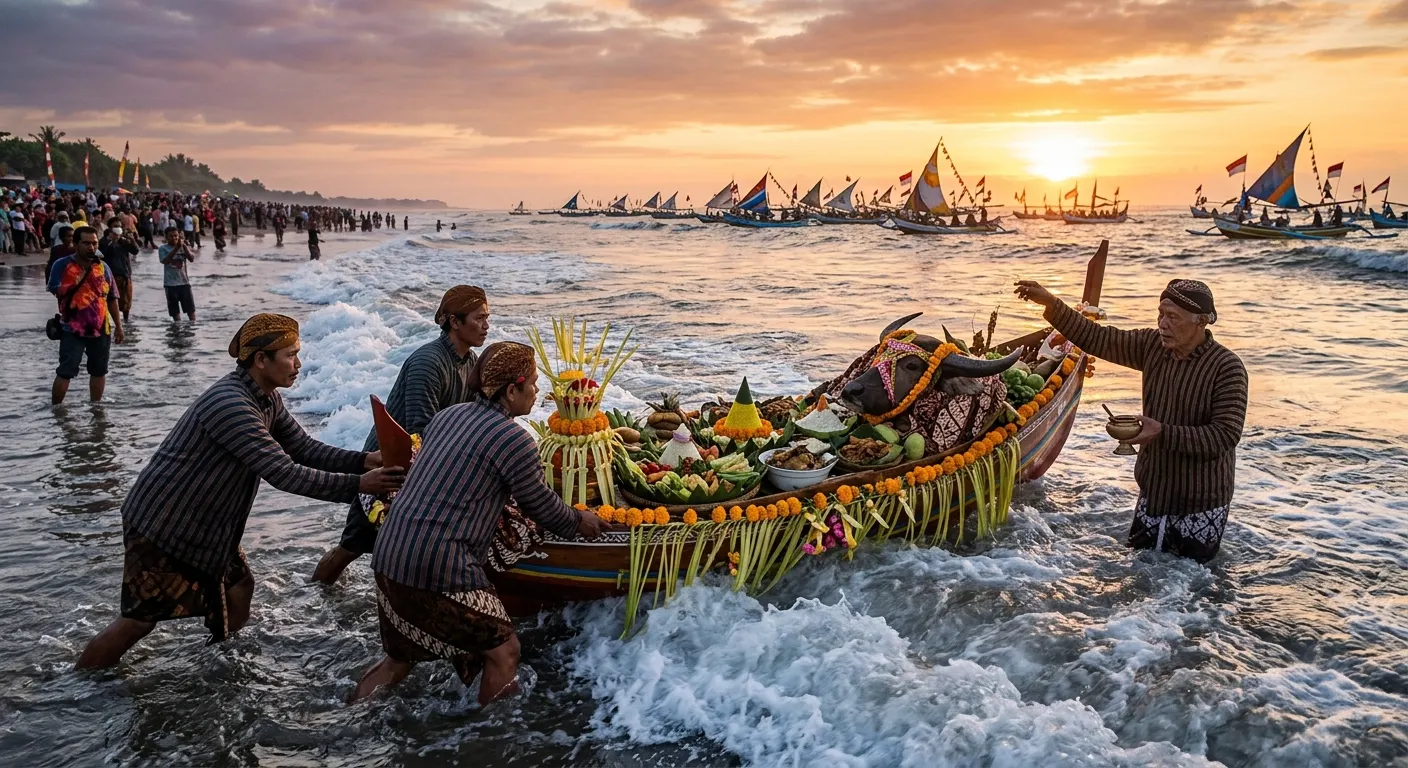
Larung Sesaji is a customary ritual in which coastal communities release offerings into the sea as an expression of gratitude and a plea for safety. The offering typically takes the form of a small, brightly decorated boat or raft carrying local produce, traditional foods, flowers of seven kinds, sometimes a buffalo or goat's head, and other symbolic items meaningful to that community.
The purpose operates on several levels: thanking the sea for a year of abundant catches, praying that fishermen remain safe every time they set out, and honoring the unseen forces believed to watch over the sea, including Nyai Roro Kidul, the legendary guardian spirit tied to the mythology of Java's southern coast. The ceremony is usually held once a year, often timed to the Javanese month of Suro or the start of the fishing season.
The Philosophy Behind Larung Sesaji for Fishing Communities
Beneath its festive surface, Larung Sesaji carries a deep philosophy of life. Its central value is balance between humans and nature — a principle echoed in the broader Javanese philosophy of Memayu Hayuning Bawana, preserving harmony in the world. For fishermen, the sea is not a resource to exploit without limit; it is a living partner to be cared for and honored.
The tradition also embodies humility: a good catch is understood as a gift from forces greater than human effort alone, not merely the product of hard work. And it carries a strong value of solidarity, since the whole process — raising funds, preparing the offering, carrying it out to sea — is done collectively by the fishing village, strengthening the social bonds among families whose livelihoods depend on the same waters.
How Larung Sesaji Is Practiced: Rituals and Procession
The sequence usually begins days before the main event. Villagers work together to prepare the offering — building the miniature boat, decorating it with palm leaves and flowers, and gathering the produce and dishes to accompany it. The night before is often marked by communal prayer or a quiet vigil at a village elder's home or along the shore.
On the day itself, the offering is carried in procession down to the beach, accompanied by elders, community leaders, and villagers in customary attire. At the shore, prayers and incantations are recited before the offering is loaded onto a fishing boat and carried out to open water to be released. Afterward, the occasion typically continues with communal celebration on land — wayang performances, traditional dance, and lively night markets that draw visitors from surrounding villages, turning Larung Sesaji into both a spiritual rite and a shared community festival.
Nyai Roro Kidul and Beliefs About the Guardian of the Southern Sea
In many coastal areas of southern Java, such as Yogyakarta, Cilacap, and Pacitan, Larung Sesaji is inseparable from belief in Nyai Roro Kidul, the mythical ruler of the Southern Sea. The offerings set adrift are believed to be gifts to her, a way of seeking her blessing so the sea continues to treat people kindly.
This belief fits a wider pattern described in Ancestral Belief and Guardian Spirits Across Regional Traditions in Java, where nearly every element of nature — mountains, forests, rivers, and the sea — is believed to have its own unseen guardian. Along the northern coast, similar beliefs persist too, under different names and local variations.
Larung Sesaji vs Sedekah Bumi: A Sea Tradition and a Land Tradition Compared
Though both spring from the same Javanese spirit of gratitude, the two traditions have distinctly different roots. Sedekah Bumi: A Javanese Expression of Gratitude for the Earth is held by farming communities as thanks for the fertility of the soil, typically marked by a procession and blessing of crops in the rice fields or village hall.
Larung Sesaji, by contrast, centers on the sea and fishing families. Its object of gratitude is the catch, its offering is a boat set adrift, and even the spirit it honors differs — Sedekah Bumi ties to Dewi Sri as a symbol of fertility, while Larung Sesaji is associated with Nyai Roro Kidul and the guardian spirits of the sea. The distinction matters, because each tradition reflects a relationship with a different ecosystem: fertile land and the open sea.
FAQ
What is Larung Sesaji?
A tradition among Java's coastal communities in which an offering — usually a small decorated boat filled with produce and food — is released into the sea as an expression of gratitude and a request for safety.
What is the difference between Larung Sesaji and sedekah laut?
They are the same tradition. Sedekah laut is the more general term used in several regions, while Larung Sesaji emphasizes the specific act of setting the offering adrift.
Why do coastal communities perform Larung Sesaji?
As thanks for a bountiful catch, a prayer for fishermen's safety at sea, and an act of respect toward the natural and unseen forces believed to protect the ocean.
When is Larung Sesaji usually held?
It is typically held once a year, often coinciding with the month of Suro in the Javanese calendar or just before the start of the fishing season.
What does the offering in Larung Sesaji usually contain?
The offering is usually a decorated miniature boat holding local produce, traditional dishes, flowers of seven kinds, and sometimes a buffalo or goat's head as the central symbolic offering.
What is the connection between Larung Sesaji and Nyai Roro Kidul?
Along Java's southern coast, the offering set adrift is believed to be a gift to Nyai Roro Kidul, the legendary ruler of the Southern Sea thought to protect those whose lives depend on it.
Is Larung Sesaji the same as Sedekah Bumi?
No. Sedekah Bumi gives thanks for the harvest of the land, while Larung Sesaji gives thanks for the bounty of the sea. They differ in what is honored, how the offering is made, and which spirit is revered.
Where is Larung Sesaji still practiced today?
It remains alive in many coastal areas of Java, including Cilacap, Pacitan, Rembang, Pekalongan, southern Yogyakarta, and numerous fishing villages along both the northern and southern coasts.
Does Larung Sesaji conflict with religious teachings?
For many who carry it on, Larung Sesaji is understood as cultural heritage and gratitude rather than worship, often blended with religious prayer according to each community's own faith.
Has Larung Sesaji become a tourist attraction?
Yes, in many coastal areas Larung Sesaji has also been developed into a cultural festival that draws visitors, without losing its underlying spiritual meaning for the local fishing community.
Who leads the Larung Sesaji ceremony?
The ceremony is usually led by a respected village elder or customary leader who is trusted to understand the correct procedures and prayers involved in the ritual.
What is the most important philosophical meaning of Larung Sesaji?
Its most important meaning is the balance between humans and nature, gratitude, humility before forces greater than ourselves, and the solidarity that binds a coastal community together.
Larung Sesaji proves that Java's coastal communities have their own way of nurturing a relationship with nature — wisdom born from the sea, sustained by togetherness, and passed down across generations. Even amid modernization, it endures, finding new life as cultural tourism without losing its spiritual roots. Read also Sedekah Bumi: A Javanese Expression of Gratitude for the Earth, or Ancestral Belief and Guardian Spirits Across Regional Traditions in Java, as well as The Javanese Philosophy of Memayu Hayuning Bawana: Preserving Balance in the World to deepen your understanding of Javanese tradition.